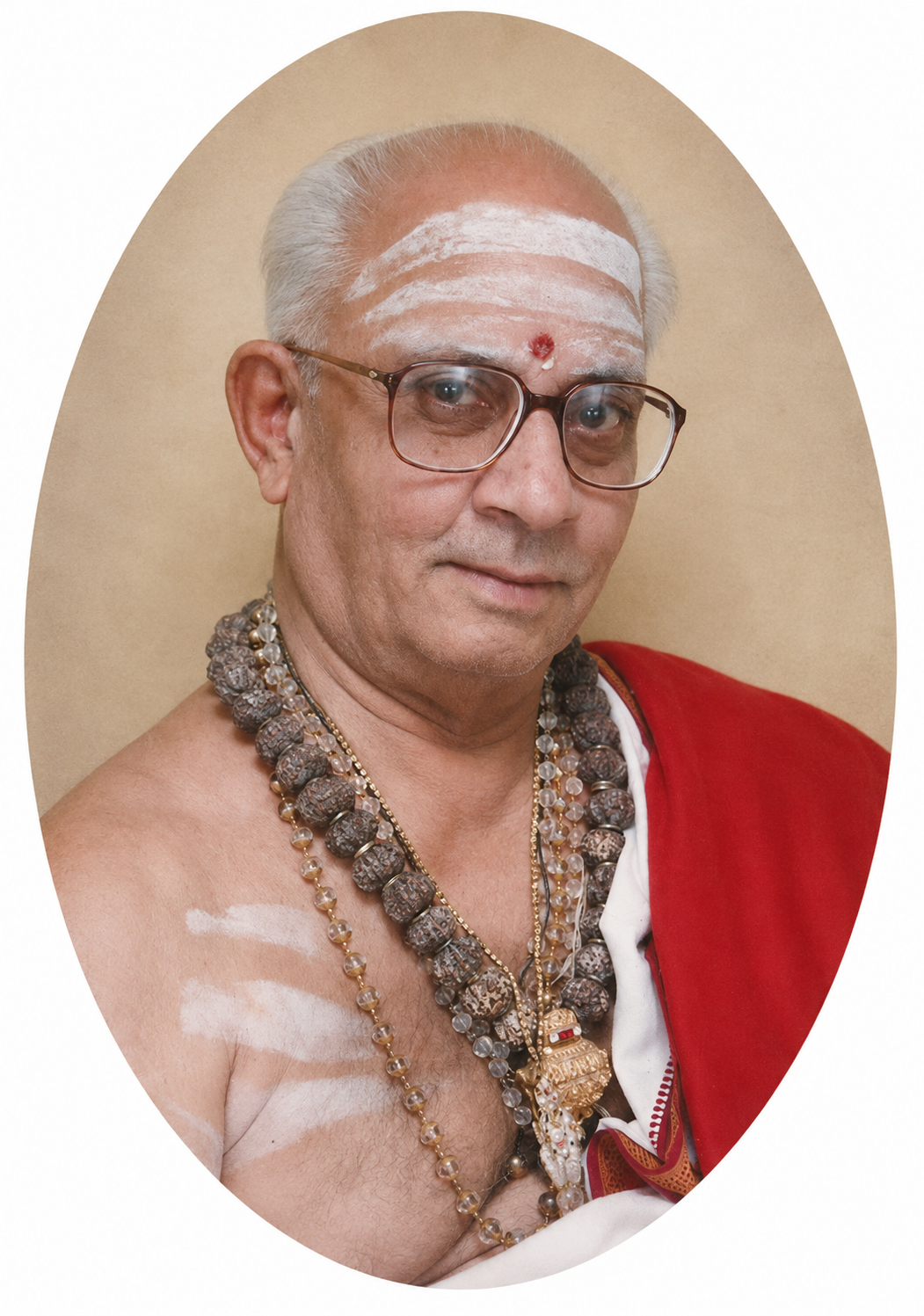
 September 15, 2003. The Sringeri Pravachana Mandapam at Raja Annamalaipuram, Chennai, wore a festive look. Celebrities from music world, pundits from devotional field, representatives from Mutts, officials, businessmen, journalists and devotees all had assembled to facilitate the Guru they held in high esteem. The Tiruppugazh music that came from Guruji reverberated all over. Now, the year was 2008, the venue was Banglore and the occasion was Golden Jubilee celebrations of Tiruppugazh. It was a mass congregation of devotees reached from different directions. On another auspicious day, the 600th birth Anniversary of Sri Arunagirinathar was celebrated at Delhi when the Government of India released a postal stamp in honour of Sri Arunagirinathar. These are few among the many milestones in the journey of Guruji Sri A.S. Raghavan, the doyen of Thiruppugaz, whose heart was full of devotion and tongue always reciting the songs of Tiruppugazh. His sparkling eyes displayed his compassion. His forehead was smeared with the sacred ash; the mark of his devoption and the chain of Rudra beads that lay around his neck symbolized his dispassion.
Sri Raghavan was born in 1928 to Sri Subbiah Sastrigal and Smt. Ramalakshmi Ammal at Arumugamangalam near Tuticorin, the sea shore famous for collection of precious gems. Unfortunately, he was affected by polio and all treatments attempted were in vain. An expert in the local system of medicine then came forward and promised to cure him. But he demanded a fee, an odd one at that. Sensing the boy’s devotional nature, the medical practitioner insisted that the child be dedicated to the service of Senthil Andavan. For the parents, no price was too heavy for the health of their dear one and they readily agreed. Besides, to offer oneself for the service of God was indeed a privilege. As the treatment progressed, the boy started showing signs of recovery. He was taken to the temple of Tiruchendur. At the very sight of the temple at a distance, the child started running easily over the vast stretch of slippery sands. He feasted his eyes at the splendor of Lord Muruga. When he returned after the worship, he got the image of the Lord of Tiruchendur firmly embedded in his mind, the image that was to make profound influence later.
After the formal education Sri Raghavan left the eastern shores of Tiruchendur and reached the western shores of Tiru Chembur in pursuit of his career. Though he took up a position in office at Bombay, it was music that was pulsating in his heart. He heard music in the drop of the rain water, in the sound of the running train and in the way the child was crying. In fact, he aspired not for a career towards material progress but an avocation of singing (“Paadum Paniye Paniyai Arulvaai”). Having settled in Bombay, he got the opportunity to learn the basics of Carnatic music from Sri Vaidyanatha Bhagawathar. Later he shifted to Delhi. Even while doing the various duties expected of him, he was humming some devotional songs. The spark that flashed at Tiruchendur was looking for an opportunity to illuminate. When music and devotion had combined, it became an ideal ground for communion with God. He felt Senthil Andavan had designed a particular role for him. ‘What was that role?’ he wondered.
That was the time when temple Othuvars, singers belonging to temple, were rendering Tiruppugazh songs in the way they had learned. The Tiruppugazh songs created a profound impact on him. He realized that the musical talent which Muruga had gifted him was meant to be used to hail the glory of the Lord. He recalled the Kandhar Anuboothi verses: “Whatever knowledge or talent that I possess are the gifts given by God to be given back to him” (Yaam Odhiya Kalviyum). As the brilliant light of Tiruppugazh awakened him, he adopted Tiruppugazh as his way of life. It became clear to him that the role assigned to him was to highlight the glory of Muruga through Tiruppugazh. .
Sri Raghavan took up the study of Thiruppugah and the more he studied, the more absorbed he became. Gradually it became a total involvement. His friends, Sri R. Narayanan, Sri M. Mahalingam and Sri Narayana Swami, who had heard Sri Raghavan singing in AIR Mumbai, joined him. They selected certain songs and set them to Carnatic based raga and thala on the lines of Chandam (rhythmic brilliance). They gave every song a distinct Raga to generate interest for Tiruppugazh among the new generation. “It was a great achievement of tuning over 503 songs of Arunagirinathar in over 110 Ragas,” said Smt. Chitra Murthy, an ardent proponent of Tiruppugazh . Arunagirinathar had prayed that he should be blessed to sing the glory of Muruga where each word would shine as a precious gem (muthu). Sri Raghavan born in a region where gems are procured in plenty, composed the first song of Sri Arunagirinathar in Koulai Raag, “Muthai Tharu”.
A system of rendering songs in a prescribed way was devised by Sri Raghavan who has now come to be known as Guruji. Under his guidance, a method of conducting Tiruppugazh Isai was developed. An orderly way of Isai Vazhipadu was established by invoking the blessings of Lord Ganesa, followed by songs related to six abodes of Muruga and other temples, Kandar Anubuthi, Alamgaram, Vel, Mayil, Seval Virutham and concluded with hymns and prayers. When the beautiful verses of Arunaginatha Swamigal acquired the sound of music, it became a wonderful form of prayer. Everyone took part in the bhajan, the talented and less talented, to convey the prayer in one voice. It became a spontaneous outpouring of devotion. Guruji and Tiruppugazh were so inalienably linked that it is impossible to think of one without the other. The foundation for a strong Tiruppugazh movement has been laid. The growth of Tiruppugazh into a wide-spread movement and the growth of Sri Raghavan into an enlightened Guru happened almost simultaneously.
Tiruppugazh classes were also started and gradually more and more students joined the classes. Those who learned from Guruji started conducting classes wherever they have settled. In the beginning (1958) Tiruppugazh classes were held at the residence of Sri G. Sundaram at Connaught Circus. Soon, the Tiruppugazh form of worship spread its branches all over. The Tiruppugazh Isai Vazhipadu was held in Uttara Swami Malai temple and Sankara Kendra at Delhi, the Chembur Murugan temple at Mumbai, Ved Bhawan at Kolkata, Kundrathur temple near Chennai, Annarpurneswari temple at Coimbatore, Ved Bhavan at Hyderabad, at Poona, at Thiruvananthapuram, at New Jersey and and at many other places. “Perhaps, there is no one who can render the verses of Tiruppugazh the way Arunagirinathar intended as exactly as Guruji,” commented Sri Subbudu, the correspondent of The Statesman.
It was clear that Tiruppugazh Anbargal were making waves. The overwhelming participation of devotees in classes and recitals was sufficient indication that Tiruppugazh culture was set to scale new heights. Wherever Guruji performed devotees assembled in large number to immerse themselves in the nectar of Tiruppugazh. Apart from Tiruppugazh Isai Vazhipadu, Guruji has also systematized an elaborate formula of Valli Kalyanam. As the Tiruppugazh movement gained momentum, it needed an administrative framework, which also Guruji helped to build. Known as “Tiruppugazh Anbargal“, it was also registered.
Awards and acclaims started pouring in. Guruji ’s contribution in creating a spiritual awakening and Muruga worship has been appreciated by heads of mutts, men of letters and great musicians. . Among the many awards he received the “Tiruppugazh Gana Rathnam” award given by Kanchi Kamakoti Peetam, “Tiruppugazh Thondar” by Abhinava Vidyathirtha Swamigal, Sringeri, “Bhakta Ratna by Swami Chidananda Maharaj of Sivananda Ashram, “Guhasri” by Thava Thiru Nataraja Sivacharya Swamigal need special mention. Though Guruji attained the pinnacle of fame, left to him, he remained always humble. “Everything happens as ordained by God and I am only a mere tool,” he said. He said among the many accolades he received, he liked the one “Tiruppugazh Thondar” because he always wished to be a mere servant to Muruga devotees.
We find triads (Trimurthis) Sri Thyagaraja Bhagavathar, Muthuswamy Dikshithar and Sri Shyama Sastrigal in Carnatic music and Sri Bhodendra Saraswati Swamigal Sridhara Ayyaval and Marudanallur Sri Sadguru Swamigal in the field of Namasankeerthanam. Similarly, we find Trimurties in the field of Tiruppugazh also like Sri Chengalvaraya Pillai, Sri Sachidananda Swamigal and Guruji. If Sri Chengalvaraya Pillai had not put in his efforts in locating the Tiruppugazh songs and done extensive research on the subject (“Arunagirinathar Varalarum, Nool Araichiyum”) perhaps Tiruppugazh would not have got the high prominence it now enjoys. That was the time when Tiruppugazh was least known among the people. These verses had to wait for centuries till Sri Sachidananda Swamigal realized its immense value and helped the songs to bloom in splendor. Among the many paths to reach God, Nathopasana is regarded as very effective. It is believed that a prayer to God addressed in music is instantly heard. It was Guruji who made Tiruppugazh as Nathopasana and helped to reach all the ears. While Vallimalai Sri Sachidananda Swamigal highlighted Tiruppugazh as Jnanamrutam (nectar of knowledge), Sri Raghavan focused it as Ganamrutham (nectar of music).
Guruji not only rendered the song but also explained the philosophy behind it. Once, while explaining the song which Arunagirinathar had done at Pazhani (Ulaka pasu paasa thontha…122) based on Saiva Sidhanta doctrine, Guruji said: “Just as the cow is tied up to the pole and not able to go farther; the individual is also tied up with attachments towards family and relations. He said the devotees should cultivate the quality of detachment and renunciation. Guruji often recalled what Sringeri Swamigal said about Tiruppugazh; “Tiruppugazh contains the essence of Vedas and Upanishads and he who recites Thiruppugazh will be elevated to high state of knowledge.”
Guruji always emphasised the three qualities the devotees should cultivate: Anbu (love) Avirodha (free from negativism) and Thondu (service). Guruji gave a good name to those dedicated to Tiruppugazh form of worship as “Tiruppugazh Anbargal”. “Tiruppugazh Anbargal“ means the vast and dedicated group of devotees who hail the glory of Muruga through Tiruppugazh. The movement they created has spread to different parts of the country and even abroad. When Thaipusam or Panguni Uthram dawns, they converge by natural instinct and join the Muruga worship with the garland of Tiruppugazh (Paamaalai). They are all united by the common bond of love and devotion. Tiruppugazh Anbargal are noted for their qualities of compassion and dispassion. When Kanda Sashti comes they observe austerities, attend Satsang and sing the songs of Tiruppugazh. When Vaikasi Visakam comes, the halls of all major cities are packed to full capacity. They come in large number, leaving all their work behind, just to come under the shower of Tiruppugazh. They worship the beautiful picture of Muruga kept at the stage along with the portrait of Guruji adorned with garlands. Listening to Tiruppugazh they forget all their worries and anxieties and they return home with a sense of fulfillment. “True devotion would help one to cultivate these values“, Guruji used to say.
In his song done at Tiruchengodu, (Baththargana Priya) Arunagirinathar says: “Devotees from all four directions, east and west, south and north listen to Tiruppugazh and keep wondering how marvelously Tiruppugazh is composed in Chandam style. Oh Lord, I would never forget the rare privilege you have given me to sing these songs and spread its glory to all corners of the world”. It appears that the same blessings, which Lord Muruga had given to Arunagirinathar, has been extended to Guruji also to continue the divine task of reaching Tiruppugazh to all the ears.
Guruji was married to Smt. Janaki. Hailing from a village in Tirunelveli District, Smt. Janaki was a lady of high virtue and devotion. She did not find it difficult to adjust to the devotional life of her husband. She too was deeply moved by the power of Tiruppugazh and took active part in Tiruppugazh recitals. The portrait of Sri Raghavan and Smt. Janaki reminds us of Lord Sri Ramachandra and Smt. Sita Devi. Tiruppugazh is not the songs that hail the glory of Lord Muruga who is another form of Lord Siva. Tiruppugazh also hails the manifestations of Lord Vishnu like Sri Ramachandra. The song rendered at Tiiruchendur accords a warm welcome to Sri Ramachandra thus: “Enthai Varuka Ragunayaka Varuka, Maintha Varuka Makane Inin Varuka” …(ThondhinSariya).
A perfectionist by temperament, an ardent devotee Sri Ramana Bhagavan and one who has travelled extensively, Guruji was a pleasing personality. He always stressed that Tiruppugazh bhajan is a collective prayer, where the individual merges with the whole. There is no distinction of any sort and all devotees are one before God. He used to make particular reference to the song, “Amala Vayu”, where Arunagirinathar makes a prayer: “Oh God, give me such as state of unity where I am not separate from the other and others are not separate from me.” It may be added that as many as 30,000 copies of Guruji’s compilation of ‘Tiruppugazh Vazhipaadu’ have been distributed at a nominal price all over the world.
The Tiruppugazh culture which Guruji has built at the root created a profound impact on the younger generation. During the Isai Vazhiupadu held at many centers on auspicious occasions like Vaikasi Visakam, it is a common sight children sitting in front and joining the rendering even without the help of the book. Once, while Thiru Muruga Krupananda Variyar was beginning his discourse on Tiruppugazh, he asked over the mike whether some boys and girls could come to the stage and render a Tiruppugazh song. He was surprised when few boys and girls came running to the stage, happy at having got the opportunity to sing and started singing very eloquently. Having witnessed this enthusiastic performance of children in Tbiruppugazh, even an arator like Sri Variyar Swamigal felt loss of words for want of adequate appreciation. He then said: “I can see Sri Raghavan has planted the seeds of Tiruppugazh very firm in the young minds and we can have full confidence that Tiruppugazh is destined to grow higher and higher”. Among the many patrons of Guruji, special mention must be made of former President of India, Sri R. Venkataraman.
Among the distinguished personalities who took the glory of Thiruppugazh to Himalayan height, special mention must be made of Sri G. Balasubramanian, Mumbai, popularly kown as ‘Thiruppugazh Mama’, a direct disciple of Guruji and his wife. If Tiruppugazh occupies a prime position among devotional literature and is adopted as a way of life by Muruga devotees today, it is largely due to the selfless service rendered by Guruji”, said Sri Vaidyanathan, who teaches Tiruppugazh to the aspirants of Coimbatore. He was a pathfinder for all of us,” said Uma Balasubramaniam, daughter of the well known Tamil scholar and orator Ki.Va. Jagannathan. Just as Lord Krishna graced the voice of Meera and Jayadevar, Lord Muruga had blessed the voice of Guruji”, said another devotee, Sri Ayyappan. It is believed that Muruga worship is never complete without a Tiruppugazh rendering. When a description is given about a Muruga temple, quite often the temple is referred as one visited by saint Arunagirinthar. When a music recital is held, invariably a song from Tiruppugazh is included. When a Tiruppugazh Isai is held, it is mostly the one tuned by Guruji.
It was hard to believe that the voice of Tiruppugazh, the voice that hailed the glory of Muruga, the voice that reverberated all over India has become silent one day. It was 17th May 2013. Sri N. Gopala Sundaram, who did the translation of Tiruppugazh songs in Kaumaram website said he was shocked at hearing the news of the demise of Guruji. Guruji was a great inspiration for me to take up the mammoth job of translation” he said. Looking back, it was a glorious life for Guruji; every moment devoted to the worship of Senthil Andavar, the eyes always centering around the image of Muruga, the ears always listening the songs and the voice always reciting Tiruppugazh. There is no doubt that he would have reached the Lotus Feet of Lord Muruga. Tiruppugazh Anbargal consider themselves blessed to be able to live in the same age Guruji lived.
It has been decided by Tiruppugazh Anbargal to conduct Arunagiri Mahotsavam by coinsiding with Guruji’s centenary. It will commence from September 2006 and will continue till 2008. Commencing from 6th September at MalaiMandir, RK Puram, New Delhi , it will continue at major cities. While the main content will be Tiruppugazh Isai Vazhipadu, there will be many events like Puja, programs for children, audio visual presentation etc. There is no doubt that Anbargal spread all over India and abroad will participate in these events very actively.
- PS. This writer had the privilege of being blessed by Guruji and also being the recipient of the Foreword Message for his book, “Thiruppugazh Glory to Lord Muruga” on 15th July 2005. V S Krishnan