The young age is a very important stage in one’s life. This is the time, like a flower that blooms in the morning, the inherent qualities of the youth unfold, the time when the perfection within manifests and the urge for spiritual knowledge rises. All that he needs is a stimulus, like the brilliant rays of the sun from which the flower blooms. The stimulus came to young Venkataraman, the son of Sundaram Iyer and Azhagammal, through an elderly relation. While on a walk, he saw his relative coming in opposite direction, Venkataraman asked him why he was not seen for some time and where was he. “Arunachalam”, replied the relative. The moment the word fell on his ears, Venkataraman experienced a flash of light within. He remained still, for a while, deeply absorbed in the word which brought a great impact on him. A few months later, another event happened in the life of Venkataraman. He found a copy of Sekkeezhar’s ‘Periapuranam’ which his uncle had borrowed from library. This was the first religious book he was laying his hand on. The book rejuvenated him beyond words. The book which described the utmost devotion of 63 Tamil saints (Nayanmars) towards Lord Siva created an enormous impact on him.
A turning point in Venkataramn’s life came sometime in 1896. Suddenly, for no reason, he was gripoped by a fear of death. He narrates his experience thus: “It was about six weeks before I left Madurai for good that the great change in my life took place. While sitting alone in a room suddenly a fear of death overtook me. I just felt ‘I am going to die’ and began thinking what to do about it. The fear made me introspective. ‘What is death? What is it that is dying?’ I dramatized the scene of death. I imitated myself as a corpse to lend an air of reality to my enquiry and lied down. I held my breath and kept my mouth closed, pressing the lips tightly together, so that no sound might escape. I said to myself: ‘this body is dead. It will be carried stiff to the burning ground where it will be burnt and reduced to ashes. But with the death of the body am “I” dead? Is the body “I”? This body is silent and inert, but I feel the full force of my personality and even the sound of “I” within myself, as apart from the body. So I am a spirit, a power transcending the body. The material body dies but the spirit transcending it cannot be touched by death. That means I am the deathless spirit, the indestructible conscious entity.” He said to himself. The death experience has paved the way for further contemplation and enquiry that ultimately led to his realization. Now, his relations his friends, his studies and the external world all appeared irrelevant to him. The feelings and emotions, attachments and aversions, taste for food, the urge for human contact all gave way for a spirit that was pulsating inside him. Soon, he heard the call of Arunachala. He decided to leave hom and told his brother that he needed some money for special class in school. “Take five rupees from the box”, the brother had replied. He took only three rupees and leaving a note that he was going to see his Father, he set out his jourey. It was a most harduous journey, by train and by walk and without even the basic food. It was on 1st September 1896. He went straight inside. It looked as though Arunachala was waiting for his son to come. He then addressed Arunachala: “Oh! God, obedient to Thy call, I have come, deserting all”. Later, he asked himself “who has seen Arunachala?” When he sought to find answer to this question, he could not say “I saw” because there was no ‘I’ to see. There was no seer. The distinction between the seer and seen having gone, he emerged with the realization that he was the immortal Atma. The world has known him as Bhagavan Sri Ramana Maharshi.
The resounding words of “Arunachalam”, the access to ‘Periyapuranam’ and the death experience have happened not without a cause. It was Arunachala who was beckoning his devotee. Once the devotee reaches near, Arunachala grabs him or swallows him. in Aksharamanamalai he says: “I came to you with the hope you would provide me food but you took me as your food and swallowed me….(Aksharamanamalai 28) When the river flows, it flows in search of ocean and when it reaches near, the ocean pulls the river towards itself and the river loses its identity. “Atman is like a powerful magnet. Hiding itself in the recess of the heart, it slowly draws the individual towards it. The individual feels as if he is striving to seek the Atman while in fact it is the Atman within that draws the individual towards it. As the proximity increases, the individuality of the Jiva ceases to exist. He becomes conscious of his supreme nature. Our effort at self-knowledge is like a divine magnetic action. The individual is striving to reach only up to the sphere where the magnetic force extends. Once he reaches there, the magnetic force draws him towards it and integrates him.”
Having lost his identity as Venkataraman, the blessed devotee threw away the sacred thread; the last vestige of his worldly identification. He threw away his clothes which marked his severance with bodily identification. At the cave nearby, he remained in Samadhi state, detached from the world, beyond body and mind. A saint, Sri Seshadri Swami observed him and started attending to his needs and some devotees also joined him. He remained absorbed in Self and a devotee named Uddandi Nayanar and his friend, Annamalai Thambiran arranged a residence at Gurumurtam. From there he moved to Pavalakunnu shrine near the hill. It was here, his mother came to take him back. He gave no response to the pleadings of the mother. Atlast, at the request of a devotee nearby Swami wrote in a paper paper and gave it to mother. “The Ordainer controls the fate of souls in accordance with their Prarabda Karma. Whatever destined not to happen will not happen, try hard as you may. Whatever is destined to happen will happen, however much you try to prevent it. The best course therefore is to remain silent”. Later, by the initiatives taken by one Palaniswamy, Swami moved to Virupaksha cave, up the hill. Here, most of the time he remained in Samadhi. “Sometime when I opened my eyes, I found it a day. At some other time, it was night. I never knew when the sun rose or set”, he said. He was unaware of the existence of body or its needs and remained unresponsive to any external moves. He studied ‘Kaivalya Navaneetham’, Adi Sankara’s ‘Viveka Chudamani’, and some other Tamil works. “As I studied the sacred books, I found that they were analyzing what I had already felt intuitively,” he said.
As number of devotees increased, Maharshi moved to a more spacious building which came to be known as Kandasramam. When the mother full of compassion now came to stay with him, he agreed. She stayed with him for 6 years, serving him and attending to his needs. When her end came, Maharshi blessed her to attain Moksha. Her body was laid to rest at the foot of the hill and the temple of Matrubhuteshwar came up at her Samadhi. Since Maharshi kept visiting this place and even stayed for some days, the place has come to be known as Ashram. Over the years, the Ashram got developed as an institution of learning. There was a continuous flow of devotees and Maharshi was easily accessible to them.
Most of the time Maharshi remained in silence and devotees viewed him as manifestation of Guru Dakshinamurthy. Maharshi was a living testimony of Jivan Mukta. He was beyond likes and dislikes, beyond attachment and aversion.. Though engaged in the worldly actions, he was detached from all external world. Though he moved over places nearby, walked around the hill, talked to people and wrote verses, deep within, he always remained conscious of Self, (Atma Nishta). He became the embodiment of Sath-Chit-Ananda (Truth-Consciousness and Bliss). He was the living example of a Self-realized soul.
There are occasions when no words came from Bhaagavan. In fact, occasion when Bhgavan spoke are much less compared to occasions when he remained “unspoken.” Bhagavan said: “Speech is only the function of the mind, whereas silence is the source all thoughts. Silence speaks volumes. It is unceasing eloquence.” Silence establishes a mental wavelength. When there is perfect understanding the conversation takes place not necessarily through words or language. The souls, finding harmony, express themselves in their own language of silence. When true silence is observed, the mind is dissolved; the world of illusion ceases to exist and one remains in perfect identification with the supreme ‘Self’.
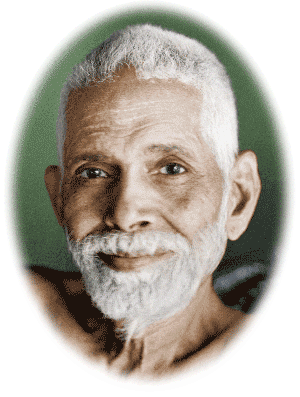
Another feature that devotees instantly noticed in Bhagavan was his beautiful pair of eyes. A devotee said: “When his beaming eyes rested on me, all my fears had gone”. In his report sent to England, Humphrys said: “For half an hour, I looked into Maharshi’s eyes which never changed their expression of deep contemplation.”Those benign eyes spoke volumes of his compassion and love. For some devotees who called on him, a mere glance from Bhagavan was enough. They took the glance itself as a mark of blessing or as an initiation (Nayana deeksha). Even seeing the photo of Bhagavan, one is captivated by the sparkle in his eyes which shined as two stars. Seeing those eyes, devotees experienced an inexplicable aura of divinity. Sivaprakasam Pillai said: “Your beautiful eyes were shedding divine grace.” Another notable feature of Bhagavan, which the devotees never fail to notice, is his smile. Frank Humphreys, a British Police Officer, who came to Maharshi said: “You can imagine nothing more beautiful than his smile. It is strange, what a change it makes in one. M.A. Piggot, an English Lady called on Bhagavan. When she saw Bhagavan smiling upon a devotee, she said she felt as if all the flowers of the world had poured their fragrance into their midst (1).
Towards the end of 1948, Maharshi was afflicted by a disease and was laid up. Expert Doctors came from Madras and treated him. Devotees came in large number to pay their reverence. Seeing the grief over their faces, Maharshi said “where can I go. I will be here.” . On April 14, 1950, while devotees were watching with tears, Bhagavan attained Maha Samadhi. A bright comet moved across the sky, reached the summit of the hill and disappeared.
Teachings of Bhagavan: The earliest available teaching of Maharshi was the one he gave in writing while he was only 21. When Sivaprakasam Pillai came and sought advice, Maharshi said: “The five elements of fire, air, earth, water, space do not constitute my “I”, nor my “self” is made of the five organs of knowledge (Jnanendriyas), nor my “I” comprises of five organs of action (Karmendriyas). The air that forms my breath and creates the energy within is also not “I”. My inner equipments (Antakaranas) do not form part of my “I”. Bhagavan said: “After you reject each of these by saying “I am not this”, the state where the consciousness, the pure ‘I’ alone remains; you are that”. “The state, Sat Chit Ananda (Being consciousness and bliss) where there is no trace of ‘I-thought’ where there is silence and peace, where there is no duality; that is your real nature (Atma Swarupa).” It is only through Atma Vichara (Self enquiry) by looking into the source of the ‘I’ and merging into that source, one is able to see the reality of Self. There are other methods like devotion or surrender which also lead to the same end; Self-Realization.”
“Realization is nothing to be gained afresh. It is already there. It is your essential nature. There is never a moment when the Self is not. It is ever-present, here and now. If it is not there or if it is something new to be attained afresh, it is not worth pursuing, because, what is got afresh will also be lost. So long there is doubt of non-realization; attempt must be made to rid oneself of these thoughts. The thoughts are due to identification with mind. “Whether you continue in the household or renounce it and go to the forest, the mind continues to haunt you. The obstacle is the mind. It must be got over, whether at home or forest.” Though Self shines as “I – I” forever, the false notion of ‘I’ or the ego continues to delude the individual into believing “I am the body”. Body inert, insentient and ever-changing. That which appears during waking state and disappears during deep sleep cannot be real. Body is only an object of perception and not to be confused with Consciousness. In sleep, one is not aware of the existence of the body. The body awareness comes only when he wakes up. If he can be in his natural state, beyond the concepts of body and mind during the sleep, it should be possible to reach that state in the waking state too. In order to rescue the individual who isunder the cloud of ignorance and restore him to his innate divine nature, Bhagavan advised the pathof Self enquiry. Self enquiry is the ideal way because it is the direct method by which one identifies those elements which do not constitute the real ‘I”, eliminates them one by one and ultimately finds the source, the reality and reach the state where there is no trace of “I-thought” where there is silence and peace, where there is no duality”. Vichara Marga is like a searchlight that is focused on a thief. The search should be made seriously to find the source or the origin of ‘I-thought’. It is like one searching a valuable item lost in the water by holding his breath (Neeril Vizhuntha Porul Kana Vendi Muzhukuthal Pol, Ulladu Narpadu Verse 28).
As the process of enquiry continues, the mind that functioned through intellect and senses would now function through the divine heart on the right side of the chest. The seat of the mind is heart. The mind lights up when it functions through the heart. We see objects in the night with the light provided by the moon which is the reflected light of the sun, but when the sun dawns, the reflected light of the moon is not necessary. It is similar in the case of mind and heart. Just as the moon shines by the reflected light of the sun, the mind shines by the reflected light from the Self. The mind is useful because of the reflection from the heart. When the mind is turned inward, the source of the light, it rests in heart and the Self shines forth like the brilliant light of the son.
When a devotee came and enquired whether there is an alternative method to Self enquiry, Bhagavan said, there are two ways; one is Self-enquiry, looking into the source of ‘I’ and merging into that source and the other is feeling “I am helpless by myself, God alone is all-powerful and except throwing myself completely on him, there is no other means of safety for me.” Thus, one gradually develops the conviction that God alone exists and submits to that Power. He moves the way the Higher Power leads him. He does not merely worship God but gives himself up to God, leaving the question of his welfare to the higher power. He does not rely on his wisdom or ability and leaves it to God to direct him to the right goal. While the Self-enquiry is the path of knowledge (Jnana Marga), surrender may be described as the path devotion (Bhakti Marga). By Self enquiry, the path of Jnana, one comes out of his false notion of ‘I’ and realizes that he is the Atman, the reflection of Brahman, the eternal reality. By surrender, the path of devotion, one considers himself not apart from God but part of God. He merges himself into God. When he identifies himself with the God, he loses his individuality, the ‘I’ notion and finds God as the reflection of his own Self. When he surrenders, he surrenders not to the external God but to one’s own Self. Thus both the paths lead to same end; leading to Self realization.
His Works: Upadesa Saram says: Karmakanda is not an end in itself. It is only a means to an end. The end is achieved only by pursuing the path of Atma Jnana. Atma Jnana itself is the end. Self-knowledge alone leads to liberation (Moksha). Atma does not perform any action. It is actionless. It is the nature that performs all actions. When the individual is not able to differentiate between Atma and nature, he starts thinking he is the doer. He is the real Karma Yogi who does his duties without being involved in it, without being attached to it, without any motivation, without any sense of doership. (Kartritva Buddhi Rahita Karma). Bhagavan wrote ‘Upadesa Saram’ in four different languages. A Malayalam Professor to whom Kunju Swami showed the Malayalam version of ‘Upadesa Saram’ said that he marveled at the diction, beauty and excellence of the composition. Upadesa Saram assumes importance because among all Bhagavans’ works, it is only here the word “Upadesa” appears.
Once, Muruganar requested Bhagavan to give his advice in a written format which the devotees of the present age and posterity would find very useful. Maharshi agreed and composed his excellent works, “Ullathu Narpathu”. “Ulladu Narpadu” takes the devotees to the peak of Advaita. The forty verses of Ullathu Narpathu The truth which Vedas, Upanishads and scriptures reveal in elaborate details has been explained beautifully in this forty verses. It is rightly described as ‘Ramanopanishad’.
This first verse conveys the message that Self which gives the consciousness of our existence is the truth. Bhagavan says: “Can there be anything real than the consciousness of being? It is the reality within, which is ever present, which is self sustaining and self-effulgent and which makes one conscious of his existence. The Self alone, shining in the heart, devoid of any thought is real. Who else can comprehend this reality other than the one who abides in the chamber of heart and realizes his essential being?” (Ullathala). Ullathu Narpathu describes how unreal the world is, how to overcome the false notion of “I”, how to reach one’s own natural state of realization through Self-enquiry. ‘Ulladu Narpadu’ is a gate-way to knowledge that leads to self-knowledge. Songs composed by sages may have more spiritual value and less poetic value and songs composed by poets have more literary value and less of spiritual value. But the songs composed by Maharshi have high spiritual and also high literary value.
Devotees who were following the practice of going round the hill Arunachala by singing, came to Bhagavan and requested him to give them a song that they can render regularly. The song which Bhagavan gave happened to be one of the outstandings songs which rings the sound of devotion in all homes and temples. Aksharamanamalai’hymn consisting of 108 verses, is very melodious in listening, marvelous in rhythm, perfect in the length of meter and very absorbing in devotion. It is acclaimed as great devotional and literary masterpiece. It is like a brilliant sun that removes the darkness of ignorance and enlightens. It is evident that no human hand could have weaved a garland of such infinite beauty; the garland that reveals the yearnings and aspirations of a true devotee to be immersed in the Lord of her heart. “He has realized the Brahman within. He has become Brahman himself. How then he could compose a song that admits of duality?” This was the question which bothered a devotee and he asked Bhagavan how he could find Arunachala apart from his own Self and express his love. “Love is not different from the Self,” said Bhagavan. “To abide in the Self, one must love the Self. Since God is Love, love of God is love of Self. That is Bhakti.
The “Arunachala Pancharatnam”, the five hymns composed by Maharshi, is a remarkable work of devotion that highlights the glory of Arunachala. The hymns vividly describe the longing of a heart for spiritual union with Arunachala. The beacon light that shines at Arunamalai is considered as the center of the universe. The mere sight of it would remove the notion of “I”, turn the mind inward and help the devotee to realize the “Self”. It is an inspiring and illuminating work that guides the devotee to the path of self-knowledge. “What a wonder,” Bhagavan says in Arunachala Ashtakam: “This hill stands still and quiet like a stone unable to perceive, but alas, it is great and incomprehensible as I knew it in my child hood. The moment I heard the name it awakened me and drew me near.” Going through the different works of Bhagavan, a devotee remarked: “He was excellent in eloquence and controlled in speech”. In his introduction to the commentary on Sat-Darshanam, His Holiness Swaroopanandaji, the Jagadguru of Dwaraka Peetha says: “Although Maharshi Ramana is no longer with us in his gross body, he has become even more pervasive in the form of his teachings. We can always behold him, here and now. For all times to come, the light of knowledge spread by Maharshi Ramana will show the way to all aspirants who have a desire for true knowledge”. Sri Sundaresa Iyer has written ‘Foreword’ to the book, ‘Sri Ramana Nool-Thirattu’ and concluded it by saying: “I believe that this book will create a better spiritual awareness in the world, remove sorrows, sufferings and disparities and elevate the readers to a state of eternal happiness”. On seeing this line, Bhagavan said: “Why do you say “I believe”; say “I am certain”.
When Bhagavan was answering questions, Munagala Venkataramiah used to be by his side. Every question that came from Bhagavan was so illuminating that Sri Venkataramiah decided to record them. The reply which Bhagavan gave to questions and recorded by Sri Venkataramiah was later published as “Talks with Sri Ramana Maharshi”. We find the real and convincing answer to many questions that men and women in different state of perception would ask.
His Disciples: Ganapati Muni, also known as Kavya Kandar who has studied Vedanta Sastra, done Japa and attained high wisdom was still thinking he has not attained fulfillment. He came to Bhagavan and said: “Please enlighten me what Tapas is”. Bhagavan said: “Closely watch where the notion of ‘I’ arises and reach its source. You will find the mind gets absorbed there. That is Tapas. If a Mantra is repeated and attention is directed to the source from where the mantra sound is produced, the mind will be absorbed there. That is Tapas”. This came as a revelation to the scholar who later composed the hymn, Ramana Gita, explaining the teachings of Swami. It was Ganapati Muni who advised all disciples and devotees to address Brahmana Swami as Bhagavan Sri Ramana Maharshi.
Those who are ever in quest of knowledge, who aspire for peace ultimately find their way to Tiruvannamalai. Kunju Swami was 23 years when he came to Bhagavan in the year 1920. In the presence of Bhagavan he found the spiritual fulfillment he aspired for. Kunju Swami served Maharshi in many ways. “Just as darkness disappears when the aruna rays of the sun appears, the ignorance goes away while being in the presence of a Guru,” he said. One day, he asked Bhagavan why the experience he felt in the presence of Bhagavan did not continue when he went away. Bhagavan said: “The answer to your question lies in the eleven verses of Kaivalyam.” Bhagavan picked up the book and read them out and explained the need to continue the spiritual practices even after one has undergone supreme experience. He said: The experience of the Self as a glimpse can occur in the presence of the Guru but it may not last. The disciple has to continue to study, introspect and practice. Listening is sravana, contemplation is manana, and practicing it is nididhyaasana. Sravana, manana and nididhyaasana should be done until the distinction between the known, the knower and the act of knowing go away. When Kunju Swami wanted to learn more about Vedanta, Maharshi said: “It is enough if you know your ‘Self”. There is nothing else to know. Learn to remain within your heart as “I AM’.” Bhagavan said: “Before you go to sleep, meditate and enquire “who am I?” When you fall asleep, the whole sleeping process itself is like abiding in Self. Morning is the ideal time for meditation. Even as you enter into the full waking state, the peace you experienced in the morning will continue to prevail. Stick on to this state.” Kunju Swami said that this is the most practical teaching which he has received from Bhagavan.
Subramanyam came to Bhagavan with his composition ‘Desika Pathigam’. Subramanyam who has come to be known as Muruganar gave up his work as Tamil Teacher and settled down in Tiruvannamalai. He adopted Maharshi as his Master and followed his teachings in letter and spirit. He said: “Seeking sanctuary, I took shelter at his feet and he, through his silent presence, removed all my fears.” Muruganar, who was in the same wavelength with Maharshi, could interpret Maharshi’s words truthfully. He noted down his experience as a disciple of Bhagavan, compiled them, got approval from Maharshi and published them in the title ‘Guruvachaka Kovai’ (The Garland of Guru’s Sayings). ‘Guruvachaka Kovai’, the collection of Bhagavan’s teachings, is an outstanding creation, which combines both the brilliance of a poet and the Jnana of a sage. He composed ‘Ramana Sannidhimurai’ on the pattern of ‘Panniru Thirumurai (Twelve Sacred Volumes) which the Saivite saints like Sri Thirunavukkarasar and Sri Jnana Sambhandar composed on the glory of Lord Siva. It is considered as one of the best works on Bhagavan’s teachings. He has composed over 30000 songs in the course of being with Bhagavan. “He alone truly knows me, who knows me as I know myself,” said Bhagavan about Muruganar.
Paul Brunton, the British national, a philosopher, came to Tiruvannamalai in his spiritual mission to know what constitutes the eternal truth. With few questions written on a piece of paper, he sat cross legged before Bhagavan and looked for an opportunity to communicate. As Maharshi looked at his eyes, he became aware of a mysterious change taking place in his heart and mind. The time stood still. He said that one by one, the questions he prepared dropped away and a steady river of quietness flowed near him. “I pluck golden fruit from meeting wise men” wrote Emerson in his diary and I could pluck whole basketfuls during my talks with Sri Ramana Maharshi” wrote Paul Brunton in his book, “A Search in Secret India”. Among the many who were moved by this book, Major A.W. Chadwick was one. He came to Tiruvannamalai and experienced the peace and tranquility that radiated from Bhagavan. “I found Arunachala my home and Maharshi as my spiritual master”, said Chadwick who came to be known as Sadhu Arunachala. A journalist went to Chadwick and said: “Leaving behind Europe which symbolized prosperity and affluence, you have come all the way to this remote part to lead a simple and quiet life in this cottage. What is it that attracted you here or what is it that keeps you going here?” Chadwick simply said: “I found peace here”.
Kanakamma’s parents, who hailed from Andhra Pradesh, were great devotees of Kanchi Paramacharya. When she visited Tiruvannamalai to see her uncle, the uncle took her to Bhagavan. The moment she saw Bhagavan, she experienced the grace that radiated from him. The peace and tranquility that emanated from him, the divine aura that surrounded him and above all his captivating smile all made an indelible impression on her. She returned home with a sense of fulfillment. The transition state when one leaves the deep sleep state and comes to the waking state is very important. When he is about to wake up and enter into a world of mind and body, the residue of happiness he felt during deep sleep, without body and mind, is still there. When Kanakamma was passing through this state, she saw a dream in which Bhagavan Ramana came and spoke to her something. Waking up, she realized it was time to withdraw from all the relations. She left her links with the outside world. Living alone in a room near the Ashram, she spent a disciplined life, like that of a Sanyasin, subsisting on minimum food and minimum necessities; her mind calm and quiet, senses under control and only ears opening up to listen to the spiritual discussions.
She found immense happiness by being near Bhagavan and listening to the replies he gave to the devotees. Bhagavan was very gracious to her. She felt a deep peace within her which lasted for many years ahead. After Bhagavan shed his mortal remains in 1950, she realized that the best way to follow the path of Bhagavan was to follow his teachings. Muruganar came to her help and taught ‘Ulladu Narpadu’, ‘Arunachala Stuthi Panchakam’, ‘Sannithi Murai’ and other scriptures. Soon, ‘an ignorant one’, as she called herself was transformed into an enlightened Rishi. She recorded the recollections of the years she spent at the Lotus Feet of Bhagavan in her book, ‘Cherished Memories”. 1st January 2010. A New Year was being born. It was the Jayanthi Day of Bhagavan, the shrine of Bhagavan looked very divine. On entering the hall, Kamalamma went round the shrine, stood before the Lingam with folded hands and then it happened. She then lost her grip, and fell to the ground. Her eyes were closed signifying that she has shed her mortal body and attained the Lotus Feet of Arunachala. 1st January 2010. A New Year was being born. It was the Jayanthi Day of Bhagavan, the shrine of Bhagavan looked very divine. On entering the hall, Kamalamma went round the shrine, stood before the Lingam with folded hands and then it happened. She then lost her grip, and fell to the ground. Her eyes were closed signifying that she has shed her mortal body and attained the Lotus Feet of Arunachala.
Reminiscences: A devotee told Bhagavan: “Many visitors from foreign countries told me that they get the grace by merely being in your presence but I being local resident have not got that experience yet, why”. Devaraja Mudaliar also raised a similar question. He said one devotee may have full faith in Guru and the other a little less. Would Guru discriminate them?” Bhagavan said that Guru would never differentiate. Grace flows from him abundantly like the ocean. Everyone draws from it according to his capacity. One who brings only a tumbler cannot complaint that he is not getting as much as one who brings a big jar”, he said.
A devotee came to Bhagavan and said: “I realize the importance and value of Self-Awareness but I am caught under the net of samsara (family life). I am unable to come out of my attachments towards my own people. Can I renounce everything that belonged to me?” Just one short reply came from Bhagavan that spoke volume. He said: “The Self has already renounced”. It is only when we cling on to our mind; the possessive spirit takes over us. In almost another similar context, Bhagavan said: “Renunciation is not discarding of externals but the cancellation of the uprising of the ego. Another devotee asked Bhagavan whether he should renounce all that he possessed. Bhagavan replied: “The possessor too”. When Sri Muruganar, the ardent disciple, sought Bhagavan’s blessing, Bhagavan’s brief reply was: “Irunda padikke iru” – “Be as you are” or remain “just being”. When Muruganar asked; “How one should conduct himself in dealing with the world”. Bhagavan replied: “Iraivan Arul seluttum vazhikke sel” – “Move as the grace of God leads you”. These two sentences sum up the teachings of Vedas.
A lady came to Maharshi and said that she perceives the world very clearly. “The relations I maintain with the family, the society and the world all appear very real and how can I take world as myth?” Sri Ramana Maharshi replied: “Was the world there when you were asleep? Did the mind or body, by which you perceive the world, exist when you were sleeping? What appears and disappears is not real. You who exist in all states and stages are real. YOU, who are conscious enough while awake and remotely conscious even during deep sleep and dreaming, are real. A saint said: “Seek the real you within rather than trying to know the unreal world around you.
“Bhagavan, how can I keep my body free from disease?” This was the question posed by another devotee. The reply came instantly from Bhagavan: “The body itself is a disease.” When afflicted by a disease, a person cannot pay attention to anything else. Similarly, a person who identifies himself with the body cannot pay attention to anything other than body and therefore the body becomes the disease. A devotee asked Bhagavan: “How can I find out what I was in my previous life?” Bhagavan replied: “Before investigating previous lives, why don’t you inquire whether your present birth itself is real?”
His visitors: Suri Nagamma was a great devotee of Bhagavan. One day, when she came to Ramanasram, she found Bhagavan seated on the cot. She then started circumambulating (Pradakshina) Bhagavan with veneration. Bhagavan said: “If you do this, others would also start doing it without knowing the significance of Pradakshina. The true Pradakshina is Atma Pradakshina, circumambulating on the Self itself. It means; “I am the Atma and many objects keep moving around me. So, you do the Pradakshina to yourself”. A devotee from Andhra, a good singer, came to Bhagavan and asked whether one can attain liberation by the exclusive means of music or whether any other Sadhana is required. Musicians like Saint Thyagaraja attained liberation only by singing the glory of God,” she added. Bhagavan replied “They have not attained realization by singing; they have expressed through songs what they already realized and that is why their songs are immortal”.
There was a devotee who came from a poor background and all he knew was simple devotion towards Bhagavan. While other devotees were asking different questions to Bhagavan, this devotee used to simply watch as he thought he was not well-versed in spiritual matters. He heard Bhagavan saying that whatever the devotee does; Vedanta studies, Dhyana, Yoga are aimed at attaining Self Realization at the end. This devotee who could not comprehend the doctrine of Advaita Vedanta merely witnessed the discussion taking place and moved away. One day, when Bhagavan was making his morning stroll on the mountain, this devotee came from the opposite direction. He carried with him a mango fruit to be offered to Bhagavan in case he was lucky enough to meet Bhagavan. Exactly, as he envisaged, he was happy to see Bhagavan and gave the fruit to Bhagavan. Though Bhagavan accepted the fruit, he gave it back to the devotee. The devotee took it as the Prasad or blessings from Bhagavan. Having got the opportunity to meet Bhagavan at close quarters, he expressed his feelings. “The other day while you were deliberating the theories of Dwaita, Advaita and Visishtadvaita, I was there but I could not grasp them. Can an ignorant person like me aspire for the high state of knowledge that you symbolize?” Bhagavan assuaged his feelings and reassured him that he is more qualified to reach the state of Jnana because he is beyond the influence of the opposites like knowledge and ignorance. Bhagavan then explained to him about the theories. “Dwaita means dual. You are there and apart from you the fruit is also there. This is Dwaita. When you put a slice of mango into your mouth, the fruit is in you. Then, both you and fruit, though different, appear as one. This is Visishtadvaita. When you take the fruit completely and the fruit get fully digested, you and the fruit become one. This is Advaita.”
Even one who has known Bhagavan from very close quarters cannot assume what a reply Bhagavan would give to a question. Even if he assumes some of the possible answers of Bhagavan, when the reply does come from Bhagavan it would be something which he could have never imagined. Once, Sri Devaraja Mudaliar asked Bhagavan: “How it will be when a devotee gets the glimpse of the Self and experience the Brahman within?” Bhagavan replied: It will be like the state of a thief who had been stung by the scorpion while indulging in the theft.”
There is a view that Sri Dakshinamurthi has manifested as Bhagavan Sri Ramana in order to highlight the importance of silence, the view subscribed by his disciples like Smt. Kanakamma, Sri T.K. Sundaresa Iyer and others. Sri Muruganar, Bhagavan’s closest devotee, has heard this revelation from Bhagavan himself. Bhagavan said that Guru Dakshinamurti expressed happiness at the earnestness shown by Sanakadi rishis and out of compassion towards them answered their question. The answer given to one question resulted into a doubt and the doubt led to another question. The doubts were followed by questions. At last, the Yogiraja went into a deep spell of silence, prompting his students also to reach a state where the doubter or the questioner has ceased to exist. While Bhagavan was narrating this incident, Muruganar said that he found no mention in texts about Sri Dakshinamurti speaking any word. Bhagavan then said: “Yes, that is what actually happened.” The assertive way in which Bhagavan said it indicates that he was Sri Dakshinamurti himself. Muruganar who was present then said “Yes, Guru Dakshinamurthi knows”. In the hymn he composed on the glory of Guru (Gurustuti), Sri Kavyakantha Ganapati Muni said: “Obeisance to the line of preceptors with Dakshinamurti in the beginning, Sri Sankara in the middle and Sri Ramana in the end”.
Sri T.K. Sundaresa Iyer has narrated an event that revealed the traces of Sri Guru Dakshinamurti in Bhagavan. “It was a Sivaratri day. After the worship at Mother’s shrine and dinner, the devotees gathered around Bhagavan, paid obeisance to him and requested him to explain the meaning of the hymn to Dakshinamurti. Bhagavan has agreed. They took their seat and continued sitting but no word came from Bhagavan who continued to remain in silence. The clock struck nine, then ten and continued till three in the morning. The devotees remained beyond time, beyond body and beyond mind. Soon, the listener and the act of listening have ceased and only peace, serenity and stillness prevailed. “Now you have heard the essence of Dakshinamurti Hymn”, Bhagavan said (1).
Most of the time, Bhagavan remained in silence and even when he had to use the medium of words, he used very few words. Mostly, he maintained in divine silence. In fact, he guided the devotees and taught them in silence. In her commentary on ‘Anuvada Nunmalai’, Smt. Kanakammal says: “That Acharya Ramana is but an avatar of Lord Dakshinamurthi can be proved by recalling many incidents from his life. Most of the time, Bhagavan remained seated in the hall facing south. He always remained in silence and conveyed the advice (upadesa) in silence. When, as a 16 year youth, exuding an aura of beauty, he was seated in silence, he could be rightly described as a Young Guru (Gurur Yuva) and there were aged disciples like Sri B.V. Narasimha Swami and Gambhiram Seshaya. (2) This reminds us of the lines of Dakshinamurti Ashtakam: “What a wonder under the banyan tree! While all the disciples are old and grey haired, the teacher with his thick locks of black hair, exuding an aura of youth and charm, clears all doubts through the simple means of silence”. (“Sitram Vadatharor Moole Vrutha Sishya Gururyuva, Krosthu Mounam Vyakyanam, Sishyasthu Sinnasamsaya”).
Truth is beyond words and beyond expression. Truth can never be explained in words. Truth does not admit of explanation. No word or language can convey the message of truth as effectively and eloquently as silence. Words give expression only to thoughts which come from mind and therefore always colored by ego. When the mind is still, it stops generating thoughts and creates the ideal ground for communication. When a person remains thoughtless and speechless, he understands the other by means of the universal language of silence. Emerson said that “Soul understands another soul by its own power without the need of any word”. The souls, finding harmony, express themselves in their own language of silence. Silence conveys a message eloquently and is understood by one who too knows the value of silence. It is the words which obstruct the silent communication.
Bhagavan said: “Speech is only the function of the mind, whereas silence is the source and origin of all thoughts and speeches. If speech is effective, silence which is the origin and source of all thoughts must be more powerful. Silence speaks volumes. It is unceasing eloquence.” Silence establishes a mental wave length. When there is perfect understanding the conversation takes place not necessarily through words or language. The souls, finding harmony, express themselves in their own language of silence. When true silence is observed, the mind is dissolved; the world of illusion ceases to exist and one remains in perfect identification with the supreme ‘Self’. The best Upadesa (advice) the Guru gives is in the form of silence. It is the perfect upadesa. When Guru remains in silence, peace prevails everywhere. His silence is vast and more emphatic than all the sastras put together . According to Kunju Swami, the silence that emanated from Maharshi was a Dhara, the perennial flow of an under-current. Devotees came from distant countries, sat before Maharshi in silence and went back with a sense of fulfillment because they experienced having communicated with Bhagavan through silence. He was continuously communicating without the use of words and devotees who did not look for words received the message of truth in clear and eloquent terms.
Swami Tapovanamm the Guru of Swami Chinmayananda said: “Silence is Truth. Silence is Bliss. Silence is Peace. Hence, Silence is Atman. To live in this Silence should be the Goal. It is Moksha. Sri Ramana Maharshi was an embodiment of such a Silence. He was the Silence itself. I had the good fortune of having darshan of the Maharshi at Tiruvannamalai when he was living in a cave along with his mother and brother. A young Brhmachari at that time, I climbed the hill and saw the Maharshi there. The Maharshi looked lovingly into my face. That was all. He spoke in Silence. Not a word passed between us. A supreme, dynamic and divine Silence prevailed. An hour passed by, all in Silence. He rose for his meals. I too rose from my seat, bowed again and walked down the hill. The divine Silence sank deeper and deeper into me.” In verse 36 of Aksharamana Malai, Bhagavan says: “Oh! Arunachala, quiet you remained, not uttering any word, as if signaling the message of silence” (Sollathu Solli Nee Sol Ara Nillenru Summa Irundhai Arunachala.
“To meet a sage and be acquainted with him is not an ordinary occurrence. It must be the result of a blessing. I consider myself fortunate to have had the privilege of meeting the Master and basking in his glorious presence for three days. To sit before him was itself a deep spiritual experience, to look at him was to have one’s mind stilled, to fall within the sphere of his vision was to be inwardly elevated”, said Sri T.M. P. Mahadevan, the Philosopher and author of “Ramana Maharshi and His Philosophy of Existence”. “Ramana was a sage without the least touch of worldliness, a saint of matchless purity, a witness to the eternal truth of Vedanta. Seldom there appeared a saint who got realization by direct experience and ever remained at peace. Swami Sidheswarananda, Head of Ramakrishna Mission said: “Maharshi has postulated a philosophy which is the essence of Vedanta. He discovered Truth on his own experience. He said: “Maharshi experienced the “Self” in its supreme, self-effulgent form. He experienced the Brahman, the eternal truth. He was the embodiment of truth. He ever abided in Self. The existence of such individuals, who are living incarnations of truth, renders the Truth demonstrable” Maharshi’s teachings are only an expression of his own experience and realization. Others find that it tallies with scriptures.
Bhagavan would time and again assert that Arunachala Hill is the manifestation of Lord Siva. The supreme presence of the Lord is experienced throughout this hilly region. “Arunachala is pure wisdom in the form of a hill. The seeker would get guidance and solace by staying near it”, said Bhagavan. Just as Kailash in the North is considered sacred, the Tiruvannamalai mountain in South commands equal veneration and sacredness. While Kailash was considered as the seat of Lord Siva, the Tiruvannamalai mountain was considered as Siva Himself. The Tamil word ‘Annamalai’ has two different meanings. The word “Anna” is used as revered brother. Arunachala Mountain is held with high reverence and respect due to a loving brother. The word ‘Anna’ also means inaccessible. Since Lord Shiva appeared in form and without form and since his end or beginning was inaccessible even for Brahma and Vishnu, Annamalai has come to be known as the inaccessible Lord of the Mountain. In fact, he is very accessible to those whose heart pulsates in devotion and he even beckons those devotees towards him. It happened in case of young Venkataraman. While walking through the road he happened to see a relative and asked him why he was not seen for some time. The relative replied that he had been to Arunachalam. The moment the word ‘Arunachalam’ fell on his ears, Venkataraman experienced a flash of light within. He remained still, for a while, deeply absorbed in the word, “Arunachala”. He then made it his mission to visit Arunachala. “When I thought of the name “Arunachala” you have pulled me towards you”, he said later in Akksharamanamalai.
In his 11 verses of Arunachala Padhigam, Bhagavan says: “I do not think of you nor do I have great love towards you, I do not melt in devotion but still you graced me and claimed me as your own. But later on, you left me half way. Though you overpowered me and almost swallowed me, you left the task unfinished. Oh Arunachala!, do not leave me suspended between life and death. Take me unto you”. Though it appears that Bhagavan was pleading here for himself, in fact he was praying for all of us.
The “Five Hymns to Arunachala”, composed by Maharshi, vividly describe the longing of a heart for a spiritual union with Arunachala. The invocatory verse says: “The beacon light that shines at Arunamalai is considered as the centre of the universe and the mere sight of it would remove the notion of “I”, turn the mind inward and help to realize the “Self”. It is a remarkable work that guides the devotees to the path of knowledge (Jnana). The most outstanding work of devotion that hails the glory of Arunachala, is ‘Aksharamanamalai’ (Marital Garland of Letters) where Bhagavan, like a bride yearning for union with her lover, seeks to immerse himself with Arunachala. In one verse, he says: “Oh! Arunachala, who roots out the ego of those who thinks of you in their heart, I worship you”. In another verse (11), he says: “When sensual desires are pulling me, Oh! Arunachala, is it right for you to remain in sleep?” he says in another verse. A devotee being the subject and the God, on which he expresses his devotion being the object, implies admission of duality. Adwaita is a doctrine that seeks to remove the concept of duality and realise the God within. The Aksharamanamalai gives us the message that through pure devotion one can attain the highest state of Advaita, the state of being one with Arunachala. “When a devotee asked Bhagavan what the underlying message of Aksharamanamalai, Bhagavan said that the best way to know the meaning of Aksharamanamalai is to recite it.”
Once Bhagavan was intensely look at Arunachala mountain and the devotee nearby asked: “Are you looking at the mountain?” Bhagavan said, “No, I am looking at myself. Bhagavan has totally identified himself with the Arunachala Mountain. On another occasion he said: “Just as you identify yourself with the body, I identify myself with the hill”.
Girivalam’ (circumambulation), the practice of going round the sacred Hill, reciting the songs of devotion is a time-honoured tradition. Girivalam of Arunachala Mountain, where divine air prevails, is considered as panacea for all the ills of life. The devotees should go round the hill either in mouna (silence) or dhyana (meditation) or japa (repetition of Lord’s name) or bhajan (singing praises). Maharshi firmly held the view that physical disability, old age sickness or any other consideration should not deter one in undertaking the Girivalam because the spiritual benefits that one derives far outweigh the strain and hardship involved. According to him, the devotee would overcome all obstacles by walking the nine-mile road around the hill with determination and devotion. On another occasion, Maharshi said: “Really, it is difficult to describe the pleasure and happiness one gets by the practice of Girivalam. The body gets tired, the sense organs lose their strength and all the activities of the body become absorbed within. As one continues to walk, the body overcomes all weaknesses and impurities, gains good health and strength. The varieties of medicinal herbs around the region also create a good impact.” It is emphasized that while walking through the region, no other thoughts should enter the mind except that of Arunachala. This is the time, when the devotee remains beyond the influence of body and mind and remains conscious of Self. In other words, even one who is not able to perform Dhyana, automatically gets the power by going through Girivalam route. It is a common sight to see pilgrims making their way through the Pradakshina route . The Maharshi often walked around the hill taking the whole day or more than a day. However, he gradually reduced the practice when he felt that by drawing the attention, he was causing inconvenience to others. Normally, when Bhagavan gave a piece of advice, he would never ask the person later whether he followed that advice but he held so much importance to Girivalam that he used to insist and even ask “Have you gone?” “One should walk slowly like a woman who is in the ninth month of pregnancy,” he said.
Sri Ramana Maharshi is an ocean of peace. He spoke eloquently through silence. Even while sitting before his image and singing Aksharamanamalai, one experiences peace and tranquility. He transcended the the three Gunas and attained the highest state of Turiya. He was a living example of a Karma Yogi which Bhagavan Krishna described in Gita. He had the direct experience of Self. He was beyond knowledge and ignorance. He was jivanmukta, liberated even while alive. It was said that the existence of such an individual renders truth demonstrable. Maharshi has only shed his mortal body. He continues to live with us, guiding us, correcting us, advising us; all that one has to do is to lend his ears, to lend his attention and give up his mind. Maharshi’s parting words should always be kept in mind: “”Where am I to go, I shall remain with you”.
