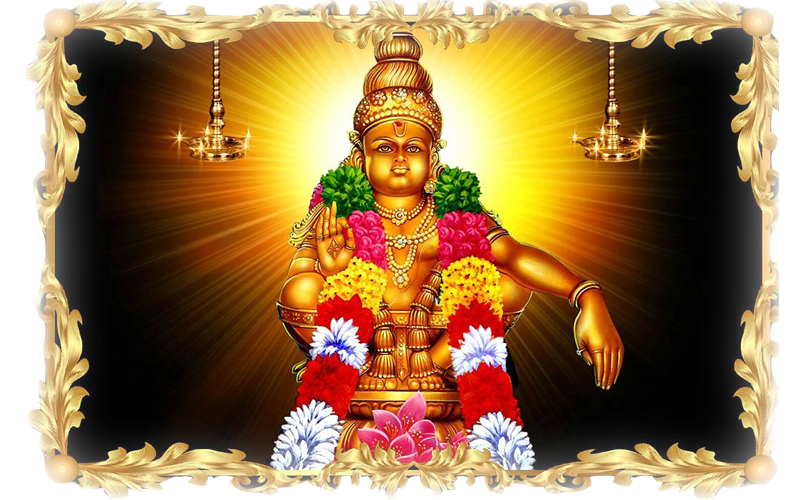
Lord Ayyappa, who has his abode at Sabari Hill, is the Lord most loved, venerated and worshipped. He is known by different names; as Dharma Saastha, who promotes the principles of Dharma, as Kaliyuga Varadha, who saves the land from the adverse effect of Kali age, as Hari Hara Putra who symbolizes the unity of Saivam and Vaishnavam, as Manikanda, who appears with the chain of golden bells around his neck and as Karunakara, the Lord full of compassion,. According to legend, Ayyappa manifested on earth to put an end to the evil forces represented by demoness Mahishi, to protect devotees and revive the age-old principles of Sanatana Dharma. The birth occurred as a result of union of Vishnu in Mohini form and Siva because the demoness Mahishi had been granted with a boon that only a combined strength of Siva and Vishnu could kill her. After the birth, the child was left on the banks of Pampa River where King Rajesekhara of Pandalam found him, wearing golden chain of bells, brought him to the palace and adopted him as his son. Growing up as a charming youth, Manikanta went out, fulfilled his mission and returned majestically riding a tiger, with bow and arrow. Whatever affluence and abundance the palace life held, Manikanda turned away from it all and went to Sabari Hill, where peace, silence and solitude prevailed. He found it as his permanent abode where he could pursue Yoga. He told the King that he would remain there ready to bless the devotees coming here. He has also prescribed certain qualities for the devotee, such as a mind free from attachments and a heart full of devotion. “I will be visible to all in the form of flame of light (Jyothi) on the occasion of Makara Vilakku,” he said.
A decision to visit Sabari Hill is not taken momentarily and carried out instantly. It calls for certain preparations. When the Mandalam season starts (mid-November), the pilgrim seeks the Guru and pays obeisance to him. The tradition of venerating the Guru and adhering to his advice is the unique feature of Sastha worship. It is the Guru who initiates the pilgrim by garlanding him with the chain of sacred beads. Once, the initiation is done, the devotee is transformed into a different and divine personality. His whole life style, his conduct and even his form of dress undergoes change. He mentally distances himself from the family and the world. Wearing black attire, he visits temples, attends bhajans and leads a life of celibacy, austerity and discipline. Seeing his divine face, forehead smeared with sacred ash, the chain of Rudraksha beads around his neck, people address him as “Swamy”, the term normally referred to God.
The ‘Swami’ who has gone through the period of austerities and discipline is now ready to undertake visit to Sabari Hill. Accompanied by the Guru, he embarks on his journey with Irumuydi on his head. “Irumudi’, the twin bag, consists of ghee filled coconuts and puja articles. Worshipping at temples on the way, the devotee reaches the sacred Pamba River, takes a bath and gets refreshed and purified. Trekking through steep terrains and forest, he reaches the sacred 18 steps that lead to the deity atop. The number 18 represents the 18 chapters of the Bhagawad Gita and 18 sub-divisions of Puranas. In no other temples, steps leading to the sanctum sanctorum are so much venerated as in Sabari Mala. Every step the devotee takes is a step closer towards Lord Ayyappa, who only waits there to see his devotees and bless them. As he reaches the top, the devotee notices the prominent words inscribed atop the temple; “Tatwamasi” (You are That). The devotee gets the message: “You are not a mere individual in the realm of body, mind and senses. You are the Self, shining as the reflection of Brahman. You are That”. Reciting the names of Lord Ayyappa, the devotee consigns the coconut over the flames of fire. It signifies that he discards his bodily attachments. When the ghee is offered to the Lord, it symbolizes his merger with God. He now joins the multitude of devotees and gets the glimpse of Sri Dharma Sastha. Standing before the deity with his hands folded, the devotee is delighted and transcended. Lord Sri Dharma Sastha appears in the posture of Siva Yoga. The Jnanamudra sign where the tips of the thumb and index fingers join together symbolizes the individual’s union with eternal reality (Jeeva Brahma Aikyam) while the other three fingers representing mind, body and intellect remains apart. He now returns with great spiritual fulfillment. Even after his return, while carrying out his worldly duties, he observes the same discipline, the same devotion and same detachment and remains conscious of Sastha’s presence within.
Sastha Worship: Sastha Worship’ is unique for many reasons. The two words which the devotees often recite are “Swami Saranam”. The words signify surrender (Saranagati). The Harivarasanam song also says “I surrender unto you” (Devam Ashraye). Saranagati was the advice Lord Krishna gave to Arjuna: “Abandon all varieties of Dharmas and simply surrender unto Me” (Sarva Dharman… BG 18-66). Saranagati forms the basis of Vaishnavite tradition propounded by Sri Ramanucharya. The essential teaching of Buddhism is “take refuge unto Buddha, take refuge unto Dharma and take refuge unto Sangham”. According to Sri Ramana Maharshi, surrender means rejecting everything that relates to the ‘I-notion’ and accepting whatever that is the will of God.
Apart from leading a life of renunciation, celibacy and surrender and apart from visiting temples, a Sabari-hill bound devotee never misses to attend the Satsang called Sastha Preeti. Sastha Preeti, literally means pleasing, appeasing or praising the Lord Dharma Saastha. All devotees sit together before the image of Lord Ayyappa, jointly recite the different names of Sastha and render songs hailing the glory of Lord Ayyappa. ‘Sastha Preeti’ has a glorious tradition which is traced back to a village called Kallidaikurichi in Tirunelveli District in Tamil Nadu. This village having 18 Agraharams, is noted for the Sastha temple there.
According to legend, Lord Manikandan, left the palace for a long journey and reached a village called Kolathur, near Kallidaikurichi. There was a family known as Kambangudi family because of their association with millet (Kambu) cultivation. They were well known for their service mentality. Seeing a youth passing through their village, not aware of his real nature, the family invited him and offered him the gruel made of millet (Kambu). Soon they realized that the divine personality standing before them was the supreme Lord. They prostrated at his feet and the pleased Lord bestowed His blessings to them. They became ardent devotees of Lord Ayyappa and initiated Sastha worship. Soon, a Sastha temple came up at Karandhayar Palayam, Kallidaikurichi. Centuries later, Kambankudi family and other residents of the village moved towards Kerala for better livelihood. Though during the re-location, they did not have much luggage to carry, they carried one thing close to their heart: the tradition of Sastha Preeti. It was the migrants from Kolathur who established the practice of Sastha Preeti wherever they settled in Kerala like Cochin and Palakkad. Soon, Sastha Preeti became an integral practice of Ayyappa devotees of Kerala.
‘Sastha Preeti’ starts by invoking the blessings of Lord Ganapati, chanting of Veda Mantras and followed by an elaborate form of Bhajan. The Bhajan begins with Stotram, Virutham and songs hailing the glory of Sastha. It consists of an elaborate Paddhati (prescribed practice) by which Lord Sri Dharma Sastha is invited to the venue (Sastha Varavu and Avesapaattu). The Viruthams say “we do Tapas with a view to realize God” (Adhi thavamSeikirom…). It continues with an emphasis “Sastha is ever with us” (Sastha Namakkundu). It addresses Sastha as the Lord of infinite compassion (Karunakara Kadavul). These traditional Sastha songs were composed by a devotee called Manidasar who is considered as the eternal Guru of all Ayyappa devotees. Sri Dharma Sastha responds to the invitation, manifests through a devotee, dances in trance, accords his blessings and hands over the bundle of plantain leaves to the organizer of the event to mark the beginning of the feast. A Sastha Preeti is never complete without a grand feast. It may not be possible for all devotees to undertake a visit to Sabari Hill these days because of health reasons, ever increasing number of pilgrims and long waiting hours at Sannidhanam. There is a belief that aged devotees, ladies and others get the blessings of Lord Dharma Saastha just by participating in the unique function, Sastha Preeti. Participation in Sastha Preeti is regarded as equally effective as participation in Sabari Hill visit.
When the time comes for Lord Ayyappa at Sabara Hill, the temple priests followed the practice of singing songs as lullaby while a devotee called Chengannur Kuttumani Thirumeni used to play the flute mujsic as closing ceremony. Later, it was Kulathu Iyer, hailing from Kallidaikurichi, an ardent devotee of Lord Ayyappa, who composed the song “Harivarasanam”. The song which eulogized the infinite qualities of God, was first published in Sastha Sthuti Kadambam (a garland of praises to Lord Dharma Sastha). Around 1955, after the resurrection of the temple from the fire incident, the Chief Priest Iswaran Namboodiri heard this ‘Harivarasanam’ song and was captivated by it. He then adopted it as the song to be rendered at Sannidhanam. The song, rendered by Sri Yesudas, is recited at the conclusion of the days’ ritual just before the sanctum sanctorum is closed for the night. Devotees listening to this song feel that every line of the song has the blessing of Lord Ayyappa.

|
ReplyForw |