Among all the works on Vedanta, Yoga Vasishtam stands out as the most ancient, most voluminous and most enlightening. Yoga Vasishtam is the outstanding work on Self-knowledge. The word Yoga is defined as uniting the human spirit with the divine. When the five senses and mind remain still and the intellect is inactive, the highest state of Yoga is attained. Yoga Vasishtam, attributed to sage Vasishta and authored by Valmiki in Sanskrit, is considered as the Vedanta of the highest order. It is a voluminous work consisting of 32000 verses in six broad divisions; such as dispassion, qualification of a seeker, creation, existence, dissolution and liberation
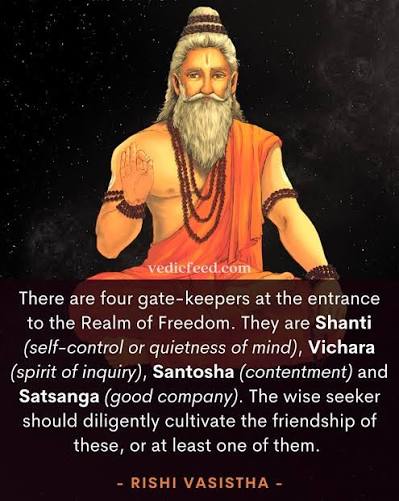
After his pilgrimage to many places, when Sri Rama returned to the palace, he was not the same. Some changes were visible in him. That was the time when sage Viswamitra and sage Vasishta were also present in the Court. At the call of Dasaratha, Sri Rama came to the Court, paid obeisance to his father and to the sages before him. On being enquired about his welfare, Rama said that what he observed during his pilgrimage has disturbed him. Addressing the sages before him, he said: “Why there are conflicts, why there are sorrows and why there are deaths? Guide me the way towards peace, towards truth and towards immortality.“ Listening to Rama, Sage Viswamitra said: “These are the symptoms of Rama’s awakening; the symptoms of his detachment; the qualities which need to be affirmed by sage Vasishta. Vasishta then commenced his marathon advice. The dialogue held between Sri Rama and Sage Vasishta, witnessed by Dasaratha and other pundits, has come to be known as Yoga Vasishtam. Yoga Vasishtam is the revelation of Vedanta made through teachings and stories. It is the highest spiritual knowledge that takes one to his ideal destination, the liberation. But it is not easily accessible to all. Yoga Vasishtam says that there are four gates that lead to this treasure chest of Jnana and only the one who has certain qualities can enter these gates. The author of Yoga Vasishtam describes them ‘the four gate-keepers of liberation’ (Moksha Dwara Pala). The four gate-keepers symbolize peace, contentment, Satsang and Self-enquiry. Even if one acquires any one of these four qualities in good measure, he would find easy access to the other three gates. For the present, we will limit our study of these four gates and leave the rest part of Yoga Vasishtam study for another occasion.
Peace (Shanti). Peace is the ideal condition by which one can pursue his goal. All devotional activities, whether Veda Parayana or Namasankeerthan, end up with a prayer for peace. Pease alone create conditions conducive for Jnana. At the end of its Mantra, Asatho Maa Sadgamaya’ the Upanishad asserts three times: “Let peace prevail all over the universe”. According to Yoga Vasishtam, he who ever remains ever in peace is eligible to enter the first gate. When one distances himself from the world and when he does not differentiate himself from all others, he remains in peace. When he remains still and silent like Arunachala mountain, he remains in peace. Having identified himself with the Arunachala mountain, Sri Ramana remained in peace. Once, while he was looking at Arunachala Mountain, a devotee asked him: “Are you looking at the mountain?” “No”, Bhagavan said, I am looking at myself. Peace, paves way for clear vision. Peace paves the way for introspection. When one is at peace with himself, he finds peace everywhere. When one is at peace, he does not long for anything. Peace is real happiness. It is the mind which generates thoughts and disturbs peace. The best way to conquer the mind is to keep it restless by means of self-control. Meditation and Yoga are the tools which help to exercise mind control. Addressing Sri Rama, Sage Vasishta says: “He who wears the armour of self-control becomes knowledgeable and reaches the highest state of excellence. He whose mind is at peace is free from dualities such as likes and dislikes, attachment and aversions, pleasure and pain.
Contentment: Contentment means being satisfied with what one has. Contentment is the state of being fulfilled or being self-sufficient. It comes from within. But contentment does not mean refraining from self-effort. One should pursue higher objective and strive for it. However, striving is not a continuous journey. A time comes for a break and one realizes it is enough. This is the third stage of Vanasprastha when he realizes that what he has gained in material terms is enough and what he has to gain in spiritual term is more. This is the time when he stops longing for something. He has no desire for anything. A bungalow constructed opposite his house does not make any impact upon him. This is the time when his priorities change and when his attention turns towards Ramana Bhagavan who has renounced everything. He thinks of King Mahabali who gave up everything to Vamana, surrendered before him and remained contended. Contentment is the base on which the entire Hindu philosophy is built.
Another word for contentment is desireless-ness. Desire-lessness can be cultivated by reading biographies of renounced saints and following the practices of dispassion and austerity which they advocate. A Guru who initiates a Sabari Hill bound devotee and asks him to discard his desires and divest himself from the false notion of ‘I’. Rama was going to the forest leaving behind the affluence and abundance that the palace life has provided. Kausalya then asked him: “Oh Rama, having used to a luxurious life, how can you adjust to the surroundings of forest where nothing will be available. Rama said, “He who is desireless and he who is contended can find fulfillment in life wherever he is. Desire is the cause for bondage and desirelessness is the way for freedom. When the desire crops up in the mind, it should be nipped in the bud like the weed which prevents the growth of the plant is removed.
Unjavrithi is an integral part of Namasankeerthanam. Unjavrithi means going around the neighbourhood and seeking alms. Even Adi Sankara used to go with a begging bowl and ask for alms. Though the practice cannot be adopted as a way of life, the message of desirelessness it gives should be emphasized. It underlines the importance of renunciation and dispassion. Sadguru Swamigal, the doyen of Namasankeerthan, said: “When you go out and accept whatever is offered, your pride goes, the desire for possession goes and even the sense of possessor goes.” Kanchi Paramacharya was a living testimony of simplicity and austerity. Though he lived in the world, he was totally detached from it. His smile revealed that he was ever contended and ever in peace. The only possession which Bhagavan Sri Ramana had was the loin cloth and a staff (dhanda) and he was hailed as embodiment of truth. Bhagavan also used to join those who were going on Unjavrithi and even composed a song which they could recite while going from door to door. The song song, Aksharamanamalai became one of the foremost prayers of devotees.

Satsang: The third requirement is association with noble people. Among the many ways advised for spiritual up-liftment, none is regarded as most effective and most valuable as Satsang, the forum where one remains in the company of saints and sages. One experiences the light of wisdom just by being near the sages or listening to them. While being in Satsang one derives inspiration from all learned persons around. By associating with luminaries who have transcended the mind, the participant’s mind also attains purity. According to Krishna, neither Yoga practices, nor Sankya philosophy which discriminates between matter and spirit, nor study of Vedas, nor austerities, charities, sacrifices or pilgrimage draw me towards God as closely as Satsang. One may not have studied Vedas or engaged in austerities and sacrifices but one gets all those benefits by being near the enlightened personalities who transmit their divine power to all around. In the midst of his worldly activities, one should spare some time to attend the assembly of learned. “Through the company of the wise or the good, there arises non-attachment; from non-attachment comes freedom from delusion; where there is freedom from delusion, there is abidance in self-knowledge” said Adi Sankara in his immortal song, Bhaja Vogindam..
Self-Enquiry: Steeped in ignorance, the individual believes that he is a separate entity with a body and mind who experiences a real world outside him. He is not aware that the ‘I’ he refers to is merely a thought that comes from his mind. Since childhood he comes under the notion ‘I am the body’ or ‘I am the mind’. The ‘I’ is not the body or mind. “I am’ is the expression of Self which gives me the consciousness of his existence. The consciousness of ‘I exist’ is one’s first and fundamental experience. He knows all external objects through the help of his senses like eyes and ears but to know that he exists, he does not need the help of his mind or senses. He is aware of his existence even while sitting in a dark room. Though he is the knowledge absolute, the ever existing Self, the delusion comes because he identifies himself his body and mind. He should enquire who he actually is and what his real nature. As the enquiry continues, he discards all his peripheral elements like body, mind and senses and realizes the Self that is fundamental and that shines forever.
While Bhagavad Gita is the advice given by God, Yoga Vasishta is the advice given to by God. It is said that neither the ignorant nor the knowledgeable is eligible to study it and only the one who thinks “I am bound” is entitled to study it. Yog Vasisht is not addressed exclusively to Ram, who is already an Uttam Purush, perfection personified, but to all those who are obsessed with the material life.