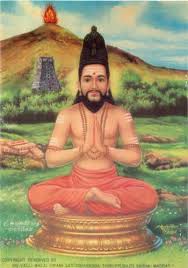
“Having taken birth in this world, the baby starts crawling over the ground, as kid speaks few babbling words, as child takes few steps forward and as young lad starts playing. As he reaches the age of 16, his mind starts working and his innocence goes away. Rather than studying scriptures or seeking the company saints, his attention turns towards feminine charm. It is only the grace of Lord Muruga that rescues him and elevates him,” says Arunagirinathar in his song Avani Thanile Piranthu.
Perhaps, Sri Arunagirinathar also faced a similar situation. Though he studied epics like Ramayana, Mahabharata, Kanda Purana, Tevaram, Tirumanthiram, as is evident from his works, he could not find peace within. Having found that his body, making diverse demands, was hindering his spiritual pursuit, he decided to discard the body itself. As he fell from the tower of Arunachala temple, alas, he found himself not on the hard surface of the ground but under the grip of two soft hands of a savior. The savior was none other than Lord Muruga who said: “You are not born to die. You are born to elevate others. Go and render songs about me, about my various abodes, about my Vel (lance), my transport (peacock) and my ensign (rooster)”. Arunagiri said: “Oh Lord, I feel blessed, but how can I, an ordinary individual, compose songs on you, whose glory even Vedas could not describe in full? The Lord then initiated him to sing by reciting the first few lines Himself. Sri Arunagirinathar then rendered his first song, “Muthai Tharu” (Give me the seed that would germinate the divine love in me leading to immortal bliss of freedom (Mukthi)”.
Taking the role of Guru, the God initiated him to the order of saint-hood (Sanyasa) and given him the Upadesa (advice). Arunagirinathar then went to the temple at Vayalur, received blessings from Lord Ganesa for his mission of hailing the glory of Muruga to all corners of the world. As songs came one after another, hailing the glory of Lord Muruga, he became the cynosure of all eyes and ears. His eloquence and erudition was noticed even by the King of the region, Prabuda Deva, who invited him to the Royal Court to render Thiruppugazh. One day, after worshipping Arunachala and mother Unnamulaiyar, Arunagirinatha Swamigal set out his pilgrimage. Apart from the six sacred temples, Arupadai Veedu and many other temples in Tamil Nadu, he went to Kasi and then to Kadirkamam in Sri Lanka and rendered songs, instantly composed, on the significance of each temple. With the grace bestowed on him by the Lord, songs came one after another like water gushing forth from a reservoir. Every song that came from the poet was unique for the spirit of devotion it kindled, for the light of Jnana (real knowledge) it radiated, for its excellent composition, for the beauty of Muruga it portrayed, for the music it reverberates, for the concordant notes of Taaal (time-measure) it denotes, for the message of one-ness (Advaita) it conveys and above all for what it grants to the aspiring devotees; the liberation or Mukthi. A study undertaken has revealed that Arunagirinatha Swamigal has composed over 16,000 songs.
Thiuppugazh is described as nectar (Amrutam) which means immortality (Mrithyoma Amrutam Gamaya). It is also described as giant tree (Karpaka Vriksha) that fulfils the different aspirations of the individual. There are songs that prays for basic necessities like clothes to wear (Udukka thukil Vendum), for a house to reside (Antarpathi Kudiyera), for a body free from disease (Irumalum roga) for the grace of the Lord (Ainkaranai yotha manam), for a heart full of devotion (ethirilaatha Bakthi thanai mevi), for a mind free from thoughts and worries (Manakavalai), for a life free from the consequence of Karma (iruvinai anja). But, these aspirations constitute only the lower portion of the tree called Thiruppugazh. If only one takes a higher look at the huge tree and reaches out, he would find precious fruits of knowledge. It was this fruit of knowledge (Jnana Pazham) Lord Muruga symbolizes at the sacred temple of Palani. Sage Arunagirinathar rendered several songs at Palani which conveyed the message that rather than gaining, there are many things to discard like ego, pride, anger, attachment and aversions. The sage says: “Oh Muruga! Tell me the way to reach a state where I discard all the impurities surrounding me and where I remain conscious of my Self.” (Adaikela porulaam) In the song rendered at Tiruvannamalai, the saint-poet says: “Oh Arunachala!, as I chant your sacred name in different ways like ‘Sivayanama’, ‘Masivayanama’, ‘Namasivaya’ ‘Vayanamasi’, as my eyes are focused and heart engrossed on you and as I hail your glorious names, I prostrate at the effulgent mountain which symbolizes your holy feet. Oh Arunachala! Would I not imbibe the nectar that flows from the ocean of your grace and reach your Lotus Feet?” (Jaya jaya Aruna).
Thieves are those who come from outside, sneak into house, grab precious articles and run away. The outside thieves who come and go are forgotten but not the thieves who come from within and stay permanently. “The thieves who come and prevent me from self-realization are the senses,” says Arunagirinathar in this song (Indhiriya sanchalangalai aruthu). In this song he says: “Let me transcend myself to a state beyond thoughts, beyond speech, beyond action and remain conscious of my true nature.”
Apart from Thiruppugazh, another outstanding work of Arunagirinathar is Kandhar Alamgaram. When devotees have adorned Lord Muruga with the garland made of different flowers, (Poomalai), the Tiruvannamalai poet has adorned the Lord with the garland of songs (Paamalai). These 108 verses, portray the splendor and glory of Muruga, His compassion, His benevolence, His knowledge, His velour, the power of his weapon, the Vel, the peacock his transport and rooster his ensign. Here, he emphasizes the need to distance oneself from the world of illusion (Maya), the need to cultivate the qualities of Viveka and Vairagya, the need to walk the path of truth and the need to know Muruga shining in the heart as Self. In one verse, he says: “Oh Muruga, come as a support to my vision so that I can see through my inner eyes what is real. Come as a support to my organs of speech by which I always speak the truth. Grace me to chant your sacred names so that I may be relived of the e consequence of my past karmas. Come as a guardian while I walk through the lonely path towards death to give me strength. (Vizhikku Thunai.)
A devotee said that Thiruppugazh is a floral offering that is woven with the fragrance of Tamil, the sacredness of Sanskrit and the lotus flower of Vedanta, all joined by the common thread of devotion. In the hymn starting “Senthanai Kandanai (72)” the saint affirms that there will be no downfall for those who worship Tiruchengodu Velavan and the Lord would bestow them a life of happiness and prosperity. In the song No. 90, “Malon Maruganai”, Arunagirinathar says: “Oh Lord Muruga, the son-in-law of Lord Vishnu, son of Lord Shiva, the connoisseur of the divine art of music and dance at the Court of Devas, the Lord most adored and worshipped by Devas, the epitome of knowledge, who resides at Tiruchengodu, the abode surrounded by lush green paddy fields and lakes, how fabulous and magnificent you look!. Even if Lord of Creation, Brahma, has endowed me with four thousand eyes, it would not be enough to admire your majesty and splendour to my heart’s content.”
Kandar Anubhuti is another brilliant work of Arunagirinathar. It reveals his own experience of the grace that Muruga bestowed on him. While experience is something personal and cannot be explained exactly to any other person, by the blessings of Lord Muruga, Arunagirinathar has succeeded in sharing his experience with others. There are two things an individual is normally engaged in. Either his body is busy doing something or his mind is engaged in thinking something. Seldom does he remain free from the complexities of body mind, intellect and senses. Seldom does he remain aloof from the world of false images and illusion. When the mind is turned outwards it results in bondage and when the mind is turned inwards, it results in liberation. It is only to free him from the mind, body and world and guide him to know himself; Lord Muruga gave Sri Arunagirinathar the Upadesa of “Summa Iru” which he shares in Kandar Anubhuti. Summa Iru’ means remaining quiet, still, and silent, without any body or mental activity. It means remaining in the world and yet distancing from it, without responding to any external situations. It is a state where the individual is all by himself without any distractions, where pure consciousness alone prevails. When the mind is still and silent, it stops generating thoughts and creates a congenial environment for self-awareness. When the person remains thoughtless and speechless, he understands the other by means of the universal language of silence. Having remained in a state of stillness and silence Sri Arunagirinathar had lost his individuality in total and realized Muruga shining as Atman within. He describes this experience in Kandar Anubhuti thus: “Oh Muruga, the source of all knowledge, what a grace! You have swallowed the false ‘I” in me (yaan), and as a result I could become conscious of my Self.
Kandar Andhadi consisting of 100 stanzas is considered as an outstanding creation. The word ‘Anthdi’ means ‘end of a beginning’. Accordingly, the first word of every succeeding verse started with the same ending word of the earlier verse. Besides, the first word of all the four lines was same and yet each differed in its meaning. The 54th stanza is unique as it contains only one root letter “th” throughout the four lines. Because of his brilliant way of handling Tamil verses, , Arunagiri has been described by poets and pundits as ‘Arjuna for archery and Arunagiri for vocabulary’ (Villukku Vijayan, Vakkukku Arunagiri). There is another unique aspect about Arunagiri’s Thiruppugazh. While many saints underwent penance and meditation and realized God at the end, Arunagirinathar was among the privileged few who attained God realization at the very beginning and then composed songs.
While residing at Thiruverakam, the saint also composed an outstanding song called “Thiru Ezhu Kootrirukkai” in the same way Thiru Jnana Sambhandar had rendered. He composed this song consisting of number one to seven, forming like a chariot. It is believed that merely by rendering this one song a devotee would get the value of rendering all Thiruppugazh songs. (Or Uru vaakiya). Sri Arunagirinathar has also composed Vel, Mayil, Seval Virutham and Vakuppu which are considered as panacea for all ills.
Among the 16,000 songs composed, only 1400 songs could be retrieved. Thiruppugazh is unique for many reasons. While other stalwarts rendered songs and hymns for many years and received grace at the end, sage Arunagirinathar was blessed at the very beginning. Since the songs are composed by the blessings of Muruga, the songs are said to contain a divine power and value. Thiruppugazh is unique because it is a confluence (Sangamam) of Advaita Vedanta, Itihas and Puranas. It is an excellent work which blends Saivam and Vaishnavam. A work as divine and magnificent as this was not known to the world in the beginning. It was Sri Subramanyam Pillai and his son, Sri Chengalvarayan who realized its value, retrieved the songs from different sources and made them available to all. Sri Chengalvarayan pursued vigorously and succeeded in tracing the songs which were scattered at different locations and brought them in a printed book form. Sachidananda Swamigal realized the power and value of Thiruppugazh and highlighted its glory to all corners of the world. He created widespread awareness about this simple and effective form of Thiruppugazh worship. Guruji Sri A.S. Raghavan, a great scholar and musician, composed Raaga and Tala for each songs and started a Thiruppugazh movement which spread to different parts of the country and abroad.